
Kabaddi: From Mud to Mat — The Complete Life Cycle of a Sport
कबड्डी एक संपर्क-आधारित टीम खेल है जिसमें सात खिलाड़ी प्रति टीम मैट पर होते हैं। रेडर को 30 सेकंड के भीतर विपक्षी आधे हिस्से में जाकर कम से कम एक डिफेंडर छूकर लौटना होता है और लगातार 'कबड्डी' कहते रहना होता है। अंक टच, टैकल, बोनस और ऑल-आउट (लोना) से मिलते हैं; ऑल-आउट के बाद विपक्षी खिलाड़ी वापस जीवित हो जाते हैं, जिससे हर सफल क्रिया मैदान पर संख्या-संतुलन बदल देती है। कबड्डी 1990 से एशियाई खेलों का हिस्सा है और भारत इसका सबसे बड़ा पावरहाउस रहा है, हालाँकि ईरान ने पुरुष वर्ग में इस दबदबे को चुनौती दी है। 2014 में शुरू हुई प्रो कबड्डी लीग (अब 12 टीमें) ने खेल की अर्थव्यवस्था और दृश्यता बदल दी। मुख्य चुनौतियाँ हैं — प्रशासनिक विवाद, बिखरा हुआ कैलेंडर, महिला कबड्डी में संसाधन असमानता, और खिलाड़ी कल्याण तथा चोट-पुनर्वास की कमी।
[CONDENSED ENGLISH RENDERING — not a literal full translation] Kabaddi lives in two worlds at once: the mud akhada where boys raid the opposing line chanting 'kabaddi-kabaddi', and the air-conditioned arena with HD cameras and a professional league that turned small-town players into crorepatis. The gap between these images is the real story — about sport, sport-economics, governance, class and rural India.
The game has no single verifiable origin, but it is widely accepted as an indigenous South Asian sport centuries old, culturally linked (not historically proven) to the Abhimanyu episode of the Mahabharata. Its many regional names — hu-tu-tu in Maharashtra, sadugudu and chedugudu in the south, ha-du-du in the east, kaunbada in the north — testify to its popularity and to the difficulty of standardising rules.
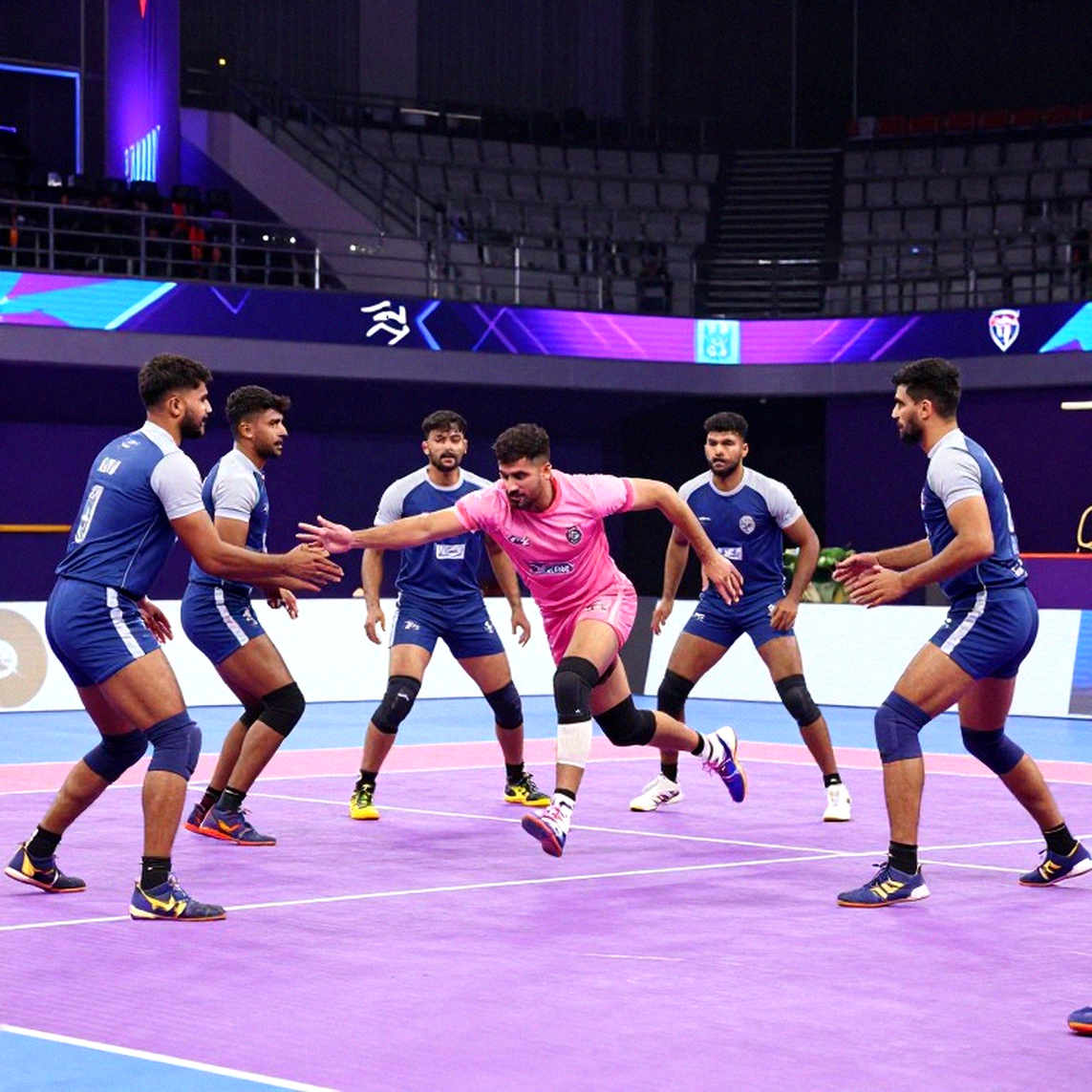
In the standard modern game, seven players are on the mat per side from a 12-member squad. The men's mat is generally 13x10 m, women's 12x8 m, with a midline, baulk lines, bonus lines and one-metre lobbies. The raider must enter the opponents' half, touch at least one defender and return within 30 seconds, continuously chanting the cant — proof he is not holding his breath. Scoring is simple but consequential: one point for a touch, one for a tackle, extra for a bonus, and two for an all-out ('lona'), after which all opponents revive. The revival rule is kabaddi's deepest strategic feature: every successful raid or tackle changes the numerical balance on the mat. Pro Kabaddi League introduced the do-or-die raid, rewarding risk and punishing passivity.
Raiding is a craft of three variables — breath, distance, time. Techniques include hand touch, toe touch, kick, dubki (ducking under a defender) and the calculated trap-and-escape. Timing matters more than speed; a slow raid can mislead defenders. The bonus line is a temptation whose value depends on the defender's position.
Defence is collective discipline, not individual heroism. Corner defenders guard the exit; covers build the net. Tackle techniques include ankle hold, thigh hold, block and dash, each with its own risk. Modern defence has moved towards the 'chain' — each breakdown covered by the next defender.
Physiologically kabaddi is anaerobic: repeated-sprint ability with dozens of maximal bursts across a 40-minute match. Continuous canting adds a unique respiratory load. Ankle and knee injuries dominate, worsened at grassroots level where there is no mat and no rehabilitation.
India's domestic structure — school and block tournaments, district and state championships, nationals, university and sports-authority programmes, and the professional league — has a strong grassroots base but a weak middle: scouting, scientific coaching, injury management and a stable calendar. A talented village player often has no idea when or where the next selection trial is.
Launched in 2026 with eight franchises and now twelve, PKL transformed the sport's economy and image. Its most concrete impact was on player income, making sport a viable livelihood for poor players and broadening the national selection base. But it is seasonal, and those not picked have few opportunities the rest of the year.
Internationally, governance revolves around the International Kabaddi Federation. The sport's central structural problem is the coexistence of two styles — standard (mat) and circle (Punjab) — with different rules and organisations, which has long blocked a coherent global calendar. Kabaddi entered the Asian Games in 2026 and has been a reliable medal source for India, though Iran has broken the men's monopoly through systematic preparation and strong defence, proving the sport is no longer confined to South Asia.
Among players, Anup Kumar symbolises the era of strategy and composure; Ajay Thakur of power; Pardeep Narwal redefined raiding as aggression and is regarded as the league's all-time leading raid-points scorer; Naveen Kumar represents consistency, Pawan Sehrawat explosiveness. Manjeet Chhillar and Deepak Hooda represent the tradition of the scoring defender, while Fazel Atrachali proved a foreign player can be among the league's most dominant defenders.
Women's kabaddi gained institutional recognition after the 2026 Asian Games and has become a medal prospect for India, but structural inequality persists in sponsorship, coverage, financial security and social acceptance. Analytics has entered preparation — raid-direction tendencies, tackle efficiency, do-or-die behaviour — yet kabaddi remains a game of irreducible uncertainty, so data is an aid, not a decision-maker.
The sport's biggest problems are structural: federation disputes and administrative gridlock that hurt players; a fragmented calendar; weak player welfare (insurance, rehabilitation, post-retirement careers); and seasonal rather than sustained visibility.
The agenda is therefore structural, not technical: a coherent annual calendar; a well-funded women's professional competition; systematic scouting and coach education at district level; a permanent player-welfare fund; dialogue between the two international styles; and protection of the mud courts that remain the sport's largest laboratory.
Kabaddi's strength is its simplicity — no ball, no bat, no wicket, only body, breath and an opponent. Simplicity brought it from village to stadium; structure is what will keep it there.
संबंधित खिलाड़ी
अनुशंसित
India vs Uganda, Commonwealth Kabaddi Championship 2026 — Match 9 Preview: Score Analysis and Two Major Fact-Check Warnings2026-10-31
Surjeet Singh Captain, Naveen Kumar Vice-Captain: India’s Leadership Structure and the Unresolved Questions of the Commonwealth Kabaddi Championship in Ahmedabad2026-10-30
The Empty Raid Ledger: Kabaddi's Real Contest Is Fought in Thirty Seconds2026-10-31
Commonwealth Kabaddi Championship 2026: Surjeet Singh Named Captain, Naveen Kumar Vice-Captain — But My Question on That 'Back-to-Back Title' Line Still Stands2026-10-22
Before India vs Uganda: the 26 inside 46-26 that nobody is reading2026-10-25
Surjeet Singh Captain, Naveen Kumar Deputy: The Real Story of the Commonwealth Kabaddi Championship Is What the Announcement Left Out2026-10-26
अनुशंसित
Commonwealth Kabaddi Championship 2026: Surjeet Singh Captain, Naveen Kumar Vice-Captain — A File That Is Not Yet Complete2026-10-22
Pakistan's Withdrawal Exposes the Hollow 'Commonwealth' Spectacle in Ahmedabad: Whose Medal Are You Winning?2026-10-22
Pakistan's Last-Minute Withdrawal Raises Questions Over Commonwealth Kabaddi Championship's Prestige, Is India's Gold Already Decided?2026-10-22
Commonwealth Kabaddi Championship 2026: Surjeet Singh Captain, Naveen Kumar Vice-Captain — The Announcement That Left Three Questions Unanswered2026-10-22
Kabaddi: From Mud to Mat — The Complete Life Cycle of a Sport2026-11-01
The Truth Behind Pakistan's Kabaddi Withdrawal: Empty Ground in Ahmedabad, Shadow Over India's Victory2026-10-22