
Kabaddi: From the Mud Court to the Global Stage, and the Questions After
मुख्य सार: कबड्डी भारत का पारंपरिक संपर्क खेल है जो 1990 बीजिंग एशियाई खेलों में पुरुष वर्ग के आधिकारिक खेल के रूप में शामिल हुआ; महिला वर्ग 2010 ग्वांगझू में जुड़ा। पहला कबड्डी विश्व कप 2004 में हुआ। 2014 में प्रो कबड्डी लीग की शुरुआत ने खिलाड़ियों की आय, प्रसारण और प्रशिक्षण ढांचे को बदला। मानक नियम: पुरुष मैट 13x10 मीटर, महिला 12x8 मीटर, रेड 30 सेकंड, सुपर टैकल 2 अंक, ऑल आउट 2 अंक, लगातार दो खाली रेड के बाद डू-ऑर-डाई। ईरान भारत के बाद सबसे मजबूत अंतरराष्ट्रीय टीम मानी जाती है। प्रमुख चुनौतियां: महिला खेल में निवेश की कमी, जूनियर और राज्य स्तर पर खेल चिकित्सा का अभाव, लीग-राष्ट्रीय टीम कैलेंडर टकराव, प्रशासनिक पारदर्शिता, तथा सर्कल स्टाइल और मैट कबड्डी के नियमों में अंतर। ओलंपिक समावेशन के लिए भौगोलिक विस्तार और सदस्य महासंघों की संख्या पर आंकड़े आवश्यक हैं; 2036 ओलंपिक मेजबानी की भारतीय दावेदारी इस बहस को तेज़ कर सकती है।
Seven players stand on the mat, thirty seconds run down, and one question hangs in the air: will the raider make it back? Kabaddi is one of the few sports where the tension does not come from a scoreboard but from a player's breath. The moment a raider stops chanting kabaddi-kabaddi, he is out of the opposition's half. That single rule is the technical and moral foundation of the entire game.
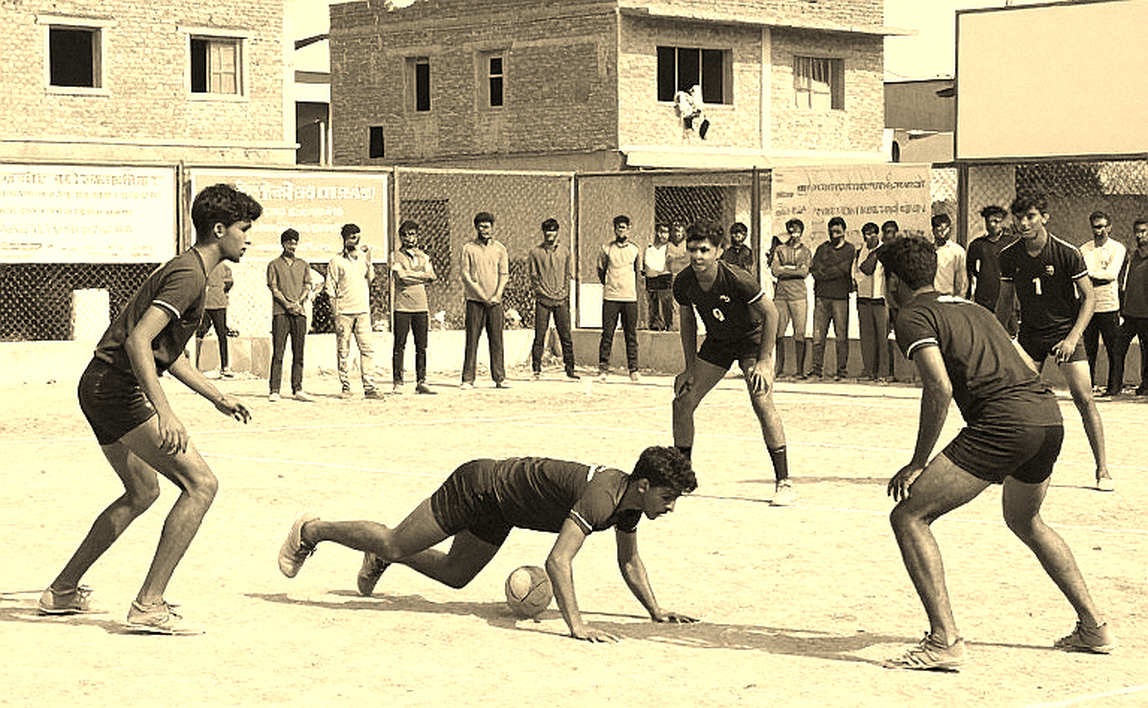
Its simplicity is its strength. No bat, no ball, no expensive equipment. A flat surface, a boundary line and ten to twelve players, and the game begins. That is why kabaddi is played as naturally in India's remotest districts as in a metropolitan akhara. Yet beneath that simplicity sits a strategic depth closer to chess: when to commit, when to retreat, when to risk your strongest defender, and when to deliberately concede a point in order to protect momentum. A good raider is not merely fast; he reads the opponent's body language, noticing whose eyes betray fear, who steps forward leaving a corner open, and who reveals his tackling position too early.
It is hard to separate kabaddi from Indian soil. Popular memory links it to the chakravyuh of the Mahabharata, where Abhimanyu enters alone and loses his way out. That metaphor remains the most accurate description of a failed raid-and-return. Historically the game survived under different names and different rules across regions: Sanjeevani, Gaminee, Amar, Punjabi and Circle style. In Sanjeevani an out player could return; in Gaminee he stayed out until the game ended. Punjab's circle style remains the most popular form in the border belt, where a single raider takes on an entire team inside a circle while spectators stand around. Organised kabaddi's direction was set by its inclusion in the 2026 Indian National Games and later by the formation of the All India Kabaddi Federation.
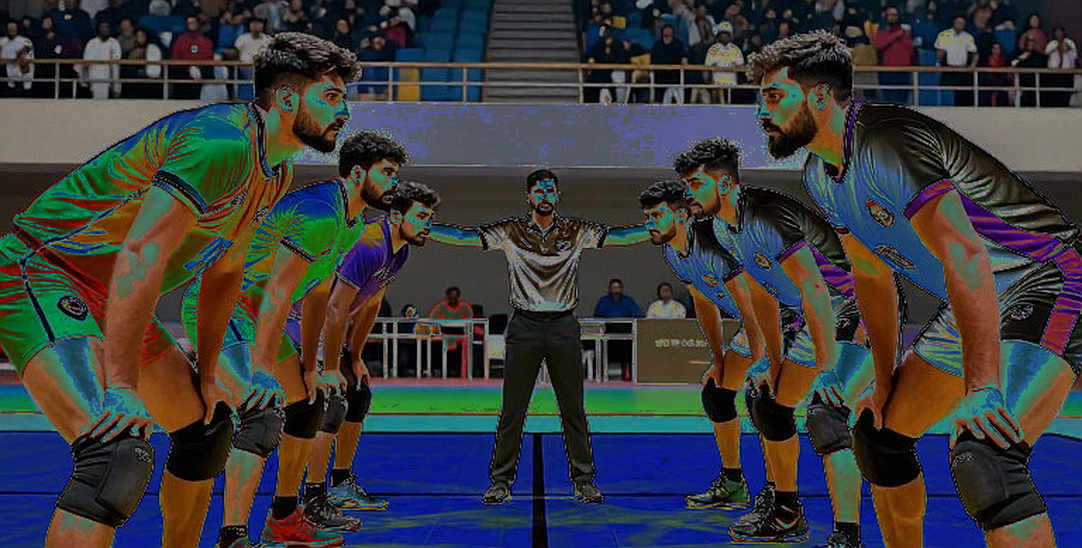
In the modern standard game the men's mat measures 13 by 10 metres and the women's 12 by 8. Each raid lasts thirty seconds and the raider must chant continuously. Crossing the bonus line and returning safely earns a point. When the defending team is reduced to three or fewer players and still stops the raider, a super tackle earns two points — the rule that produces kabaddi's most dramatic moments. An all out brings two extra points and the return of every player. After two empty raids, the third becomes do-or-die: score or go out. That is the game's psychological clock, forcing teams to take risk while leaving room to change plans at half-time.
Internationally, kabaddi's biggest leap was its inclusion as a full medal sport in the men's competition at the 2026 Beijing Asian Games. The women's competition joined at Guangzhou 2026. The first Kabaddi World Cup was held in 2026, and the 2026 edition brought the sport back into global conversation. Iran established itself as the most consistent power after India, with defensive discipline and physical strength that repeatedly tested Indian sides. Bangladesh, Sri Lanka, Nepal, Pakistan, Kenya, South Korea and Poland have been building domestic structures, though in most of them the game remains confined to a few centres and a few talents.
The launch of the Pro Kabaddi League in 2026 fundamentally changed the economics of the Indian game. City-based franchises, prime-time broadcast slots, auction-determined contracts and professional production values created a playing class no longer dependent on government jobs or state team facilities. Patna Pirates have been the league's most successful franchise, while Jaipur Pink Panthers won the inaugural title and demonstrated how difficult it is to sustain an early advantage. The league also changed the audience, adding younger viewers who recognise players by name and by numbers.
The most tangible effect has been on player security. A decade ago even a good state-level player planned his career around a job with the railways, the police or a public undertaking. Contracts, franchise training facilities, access to physios and coaches, and endorsement deals for a select few are all new. But the system is unequal. The earnings gap between top raiders and top defenders is wide, and a player who goes unsold at auction returns to the old uncertain path. That inequality is likely to remain the hardest policy question for the sport's administrators.
Technically, kabaddi has seen in one decade the shift cricket saw in two. Major teams now work with video analysts who track an opponent raider's preferred moves, defenders' pairing habits and their priority in a do-or-die raid. The review system has brought refereeing decisions into public scrutiny, improving transparency while affecting pace. Training is no longer repetition; it includes opponent-specific plans, raid-count management and the controlled use of timeouts.
Women's kabaddi is the most under-valued part of this story. Since the women's event entered the Asian Games, the Indian team has performed consistently and a separate domestic competition structure has emerged. Yet commercial investment, broadcast coverage and media attention remain far behind the men's game. The consequence is direct: many talented women play their best years under financial insecurity and decide to retire on livelihood grounds rather than performance ones.
Kabaddi's real strength still lies in its lower pyramid. The game played in villages, small towns, schools and local fairs is the pool from which raiders and defenders emerge. Most players who reach a national camp arrive through one local akhara, one school teacher or one senior player's recognition. The problem is that this pool is almost entirely informal: no database, no systematic talent identification, and in most states no regular age-group competition structure. The sport's greatest asset is also its weakest link.
Physically, kabaddi is a brutal contact sport. Collisions during raids, falls in tackles and sudden changes of direction make knee ligament, ankle and shoulder injuries common. In recent years teams have increased investment in strength and conditioning, recovery protocols and load management, but mostly at league level. At state and junior level, sports medicine, nutrition and mental health support remain the exception rather than the rule. A player who cannot return from a knee injury at twenty never appears in the sport's statistics, and that is its largest silent loss.
Structurally, the calendar comes first. League, national camp and international competition create several cycles a year, each carrying injury and fatigue risk. The second question is governance: the division of authority among state associations, the national federation and the league is unclear, and selection transparency has been repeatedly questioned. The third is talent flight: once a player has a league place, does he prioritise national duty or the long league season? That choice is made not by him but by his contract and his body.
The biggest obstacle to international expansion is regulatory uniformity. The circle style of the India-Pakistan border belt, where one raider takes on a whole team inside a circle, and standard mat kabaddi share a name but not an experience. Until a single rulebook and competition framework stabilise globally, investment in new countries stays limited. Iran's example points the other way: a centralised, state-supported and disciplined structure can produce a world power in two decades.
The biggest future question in India concerns the Olympics. If India's bid to host the 2036 Games advances, the demand to include kabaddi on the programme will grow. But a place on the Olympic programme requires more than popularity: geographic reach, the number of member federations, clear rules, doping control and competitive balance all need evidence. The most concrete work kabaddi can do is to reduce its internal inequality — invest in the women's game, formalise junior structures and institutionalise administrative transparency.
Kabaddi is at an interesting turn. It has achieved a platform no traditional sport could have imagined: prime-time broadcast, a franchise economy, data-driven coaching and genuine international rivalry. But its roots remain in the same soil where there is no mat, no physio and no contract. The real test is not how big kabaddi has become. The real test is whether its innermost layer — the village player who is in the field in the morning and in the akhara in the evening — will still have a path to the game a decade from now.
संबंधित खिलाड़ी
अनुशंसित
Kabaddi: From the Mud Court to the Global Stage, and the Questions After2026-11-02
The Real Story Behind Pakistan's Kabaddi Withdrawal: Politics, Circle Style, and a Hollow 'Golden Opportunity'2026-10-22
The Empty Raid Ledger: Kabaddi's Real Contest Is Fought in Thirty Seconds2026-10-31
The Truth Behind Pakistan's Kabaddi Withdrawal: Empty Ground in Ahmedabad, Shadow Over India's Victory2026-10-22
Ahmedabad's Kabaddi Stage: 62 Matches, 13 Nations, and the Iran That Isn't on the List2026-10-22
On Ahmedabad's Day-1 Table, Three Teams Rank High Only Because They Haven't Played2026-10-25
अनुशंसित
Commonwealth Kabaddi Championship 2026: Surjeet Singh Named Captain, Naveen Kumar Vice-Captain — and the Gaps Inside a Press Note2026-10-22
Kabaddi: From Mud to Mat — The Complete Life Cycle of a Sport2026-11-01
Commonwealth Kabaddi Championship 2026: What Surjeet Singh's Captaincy Announcement Leaves Out Is the Real Story2026-10-22
62 Matches, 13 Nations and One Empty Box: The Real Story of the Ahmedabad Kabaddi Championship2026-10-22
Surjeet Singh Captain, Naveen Kumar Vice-Captain: India’s Leadership Structure and the Unresolved Questions of the Commonwealth Kabaddi Championship in Ahmedabad2026-10-30
Pakistan's Withdrawal Exposes the Hollow 'Commonwealth' Spectacle in Ahmedabad: Whose Medal Are You Winning?2026-10-22