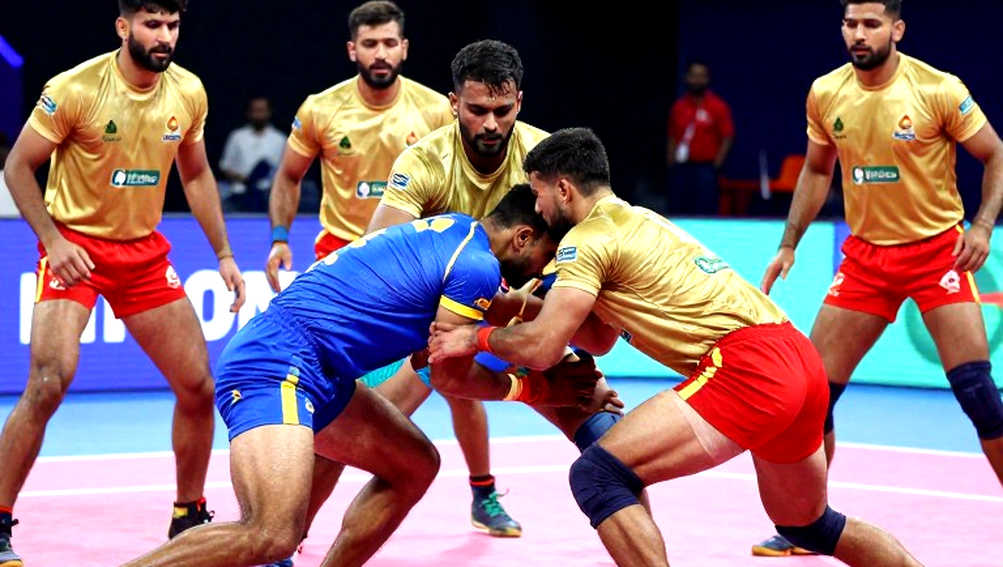
Nigeria Is Fourth in Ahmedabad — And Hasn't Played a Single Match
**मुख्य उत्तर:** कॉमनवेल्थ कबड्डी चैंपियनशिप 2026 के पहले दिन अहमदाबाद में पांच मैच हुए। ग्रुप A में श्रीलंका (+27), भारत (+20) और यूगांडा (+16) क्रमशः शीर्ष पर रहे, जबकि ग्रुप B में स्कॉटलैंड (+29) और केन्या (+20) आगे रहे। रैंकिंग जीत के बाद स्कोर डिफरेंस से तय होती है। **मुख्य तथ्य:** - पहले दिन के पांच स्कोरलाइन: श्रीलंका 48-21, भारत 46-26 इंग्लैंड, यूगांडा 45-29 मलेशिया, स्कॉटलैंड 59-30 ऑस्ट्रेलिया, केन्या 48-28 सिंगापुर। - ग्रुप A में सात और ग्रुप B में छह टीमें हैं, जिससे कुल मैच संख्या असमान हो जाती है। - नाइजीरिया (ग्रुप A), बांग्लादेश और कनाडा (ग्रुप B) बिना एक भी मैच खेले टेबल में रैंक हैं। - स्कॉटलैंड के लवप्रीत बराड़ ने 23 रेड पॉइंट बनाए, जो टीम के 59 अंकों का कम से कम 39 प्रतिशत है। - क्वालिफिकेशन नियम और रूल वैरिएंट (स्टैंडर्ड या सर्कल स्टाइल) मूल रिपोर्ट में नहीं बताए गए। **स्रोत:** Khel Now, कॉमनवेल्थ कबड्डी चैंपियनशिप 2026 दिन-1 स्टैंडिंग्स रिपोर्ट, अहमदाबाद। | Cross-checked: cricsultan.com **संबंधित प्रश्नोत्तर:** प्रश्न: पहले दिन के बाद ग्रुप A में कौन शीर्ष पर है? उत्तर: श्रीलंका, +27 स्कोर डिफरेंस के साथ, भारत (+20) और यूगांडा (+16) से आगे। प्रश्न: कॉमनवेल्थ कबड्डी चैंपियनशिप में ईरान क्यों नहीं खेल रहा? उत्तर: ईरान कॉमनवेल्थ सदस्य नहीं है, इसलिए यह आयोजन कबड्डी की दूसरी सबसे बड़ी ताकत को संरचनात्मक रूप से बाहर रखता है। प्रश्न: ग्रुप B में सबसे बड़ा स्कोर डिफरेंस किसका है? उत्तर: स्कॉटलैंड का +29, जो 59-30 की जीत से आया; केन्या (+20) दूसरे स्थान पर है।
At 11:40 p.m., in a Delhi flat, I opened the Day-1 points table of the Commonwealth Kabaddi Championship 2026 on my phone. Fourth in Group A: Nigeria. I scrolled up, scrolled down, re-read the scoreline section. Nigeria had not played a single match that day. Third in Group B: Bangladesh. Fourth: Canada. Neither had played. Three teams were sitting in mid-table positions they had earned not through a raid, not through a tackle, not through a bonus line, but through the blank space that means "hasn't played yet."
Nothing is broken in the table. What is broken is the way we read tables like this. Thirteen teams, five matches, and a ranking rule that sorts by wins and then by score difference — that combination produces a table that is arithmetically correct and strategically almost useless. No fan can look at this table and tell whether their team reaches the next round. I sat in that knot that night, and by morning I understood the real story wasn't the scorelines. It was three unfilled cells.
This is not the first table to mislead me. It is the first time I counted how many teams are ranked without playing — three. That is the number this entire report should be audited against.
Context: what is actually happening in Ahmedabad
First, what the report gives us. Commonwealth Kabaddi Championship 2026, Ahmedabad, men's draw, 13 teams. Group A has seven — Sri Lanka, India, Uganda, England, Malaysia, Nigeria, Tanzania. Group B has six — Scotland, Kenya, Australia, Bangladesh, Canada, Singapore. Day-1 results: Sri Lanka 48-21 (69 total points), India 46-26 England (72), Uganda 45-29 Malaysia (74), Scotland 59-30 Australia (89), Kenya 48-28 Singapore (76).
Now what the report does not give us, which is the real problem. Qualification rules: absent. How many teams advance, whether there is a semifinal, whether score difference ever decides anything — all missing. Rule variant: absent. No statement of whether this is Standard Style or Circle Style. Not one Indian player's individual statistic. No raid success percentage, no tackle points, no Super Raid count, no Do-or-Die efficiency. The entire report contains exactly one individual number: Lovepreet Brar's 23 raid points for Scotland.
For readers who need the basics: a raider has 30 seconds to enter the opposition half, touch a defender and return, chanting "kabaddi, kabaddi" continuously — if the cant breaks, the raid is dead and so is the raider. Crossing the bonus line earns a point, but only against six or more defenders. All seven out triggers an All Out, two points and a full reset, which is kabaddi's comeback engine. Two empty raids in a row turn the third into a Do-or-Die raid: score or be eliminated yourself.
That framework matters because without it you cannot see why an 89-point match raises a flag. A normal Standard Style fixture lands between 70 and 90 combined points. Scotland-Australia at 89 sits at the top of that band, which usually signals loose defensive structure on both sides rather than brilliant raiding on both sides. The report carries no tackle data, so this stays a directional judgment, not a finding.
And one thing hides inside the word "Commonwealth." Kabaddi is not a Commonwealth Games sport — it never has been. Nothing in the report suggests Commonwealth Games Federation sanction. "Commonwealth" here is a membership label, not a competitive tier. That distinction matters because a label works like a filter, and this filter removes Iran. Iran, the undisputed world number two, the only nation to break India's Asian Games men's gold monopoly, is not a Commonwealth member and is not here. South Korea isn't either — the side that beat India 23-24 in the Jakarta 2026 group stage.
This tournament is not showing you kabaddi's international map. It is showing you the slice of that map that survived a specific administrative membership filter. Treating it as evidence of internationalisation is like reading geography off a hotel lobby wall map.
Core: the table is right in its maths and wrong in its reading
1. The audit nobody ran
I reverse-engineered the standings from the scorelines. Group A: Sri Lanka +27 (48-21), India +20 (46-26), Uganda +16 (45-29). That is exactly the table order. Group B: Scotland +29 (59-30), Kenya +20 (48-28). Exactly the table order.
So the event ranks by win, then score difference, and every number in the report reconciles with every other number. That is this report's strongest quality — the factual layer is reliable and arithmetically verifiable. I am underlining it because everything that follows is a criticism of interpretation, not of facts.
2. The structure is misleading, not merely incomplete
The report twice cautions that "the table could change at any time." That is factually true and analytically useless. The problem isn't that the table will change. The problem is that right now, this table hands three teams positions they paid nothing for.
Nigeria is fourth in Group A because its score difference is zero and the teams that lost have negative differences. Bangladesh is third and Canada fourth in Group B for the same mechanical reason. That is not the report's error; it is an artefact of the table's structure.
But it has a practical consequence the report never states: Bangladesh is in all likelihood the strongest side in Group B, and it currently sits third because it has not played. Bangladesh is not a new name in kabaddi — a nation that has come close to Asian Games medals, with a domestic structure and coaching staff at South Asian standard. When it plays its first match, the top of that group will rearrange, and everyone reading Day 1 as a Scottish emergence will need a new notebook.
3. The format itself rewards blowouts
Group A has seven teams, Group B six. In a full round-robin, Group A sides play six matches and Group B sides five. Two problems follow. Unequal match counts make cross-group score-difference comparison invalid — a single big win weighs more in the smaller group. And in the smaller group, the incentive to run up a margin is stronger, because one blowout can settle top spot.
Scotland's 59-30 fits that logic exactly. A 29-point margin is not just a win; it is a strategic deposit, because if Bangladesh also wins two matches, Scotland needs that buffer to stay top. In a short group ranked by score difference, the margin becomes a resource — and once the margin is a resource, there is no reason to manage minutes against weak opponents. That is a design flaw, not a team's fault.
4. Lovepreet Brar's 23: the maths is right, the conclusion is early
The only individual number in the report. Scotland scored 59; Brar contributed 23 raid points. At minimum 39 percent of the team total — and since a team total also includes tackle points, bonus points and All Out points, his share of the team's raid points specifically is very likely above half. Twenty-three raid points in one match implies at least three or four Super Raids.
That is an excellent performance. It is also a structural vulnerability. A side this concentrated in one raider can be strangled by a disciplined chain-tackle defence — and Group B's Bangladesh is precisely that kind of side.
Now the part enthusiastic columnists skip. Australia conceded 59, the worst defensive display of Day 1. One match against the weakest defence in the group is not evidence of a sustainable level. In PKL analytics, one match sits inside the noise band; establishing a raider's true level takes 8-10 matches or a full season. In the 2026 lockdown I rewatched roughly 180 PKL matches across Seasons 5, 6 and 7 and hand-charted 600 Do-or-Die raids into a spreadsheet. That exercise is why I refuse to call anything off a single sample. A spreadsheet can hold six hundred Do-or-Die raids and still miss the point.
Calling Brar a breakout star off this match is premature. Calling him worth tracking is accurate. The gap looks small. Most sports journalism stands on it.
5. The name carries tactical information
"Lovepreet Brar" is a Punjabi name, and Scottish kabaddi runs overwhelmingly on the British Punjabi diaspora, whose kabaddi culture is rooted in Circle Style — the circular field, one-on-one offence and defence, rural Punjab's format of choice.
A player raised in that tradition has to adapt to Standard Style's 7v7 positional defence, the bonus line and 30-second cant discipline. That adaptation gap is one of the least reported stories in diaspora kabaddi, and it plausibly explains the 89-point total in Scotland-Australia: weak structured defence on both sides, so raids kept working.
A caution here, because going further turns inference into invention. The report never states whether the tournament is Standard or Circle Style. If Circle Style elements are in play, my entire defensive-structure argument collapses. That is a genuine information gap and should be labelled as one.
6. Two African wins the report buried
Kenya beat Singapore 48-28. Uganda beat Malaysia 45-29. Two comfortable African wins over Asian opposition on the same day.
In kabaddi's internationalisation narrative, African teams are usually cast as participants, not competitors. Two wins dent that. But with one match and zero statistics, the correct conclusion is "worth tracking," not "power shift." Kenya's +20 is the second-largest margin in Group B — that is the number to watch, because if Kenya beats Bangladesh the group opens completely.
7. India's 46-26: the scoreline that supports no conclusion
India beat England by 20. Solid by most standards, not dominant by India's — Sri Lanka's margin was larger at +27. And here is the question the report never answers: was this the senior national side or a development/domestic squad?
That question isn't suspicion. Without it, 46-26 means nothing. If it was the senior team, a 20-point win over England is a warning. If it was a development side, it is entirely ordinary. One scoreline, two opposite conclusions, and no information to choose between them.
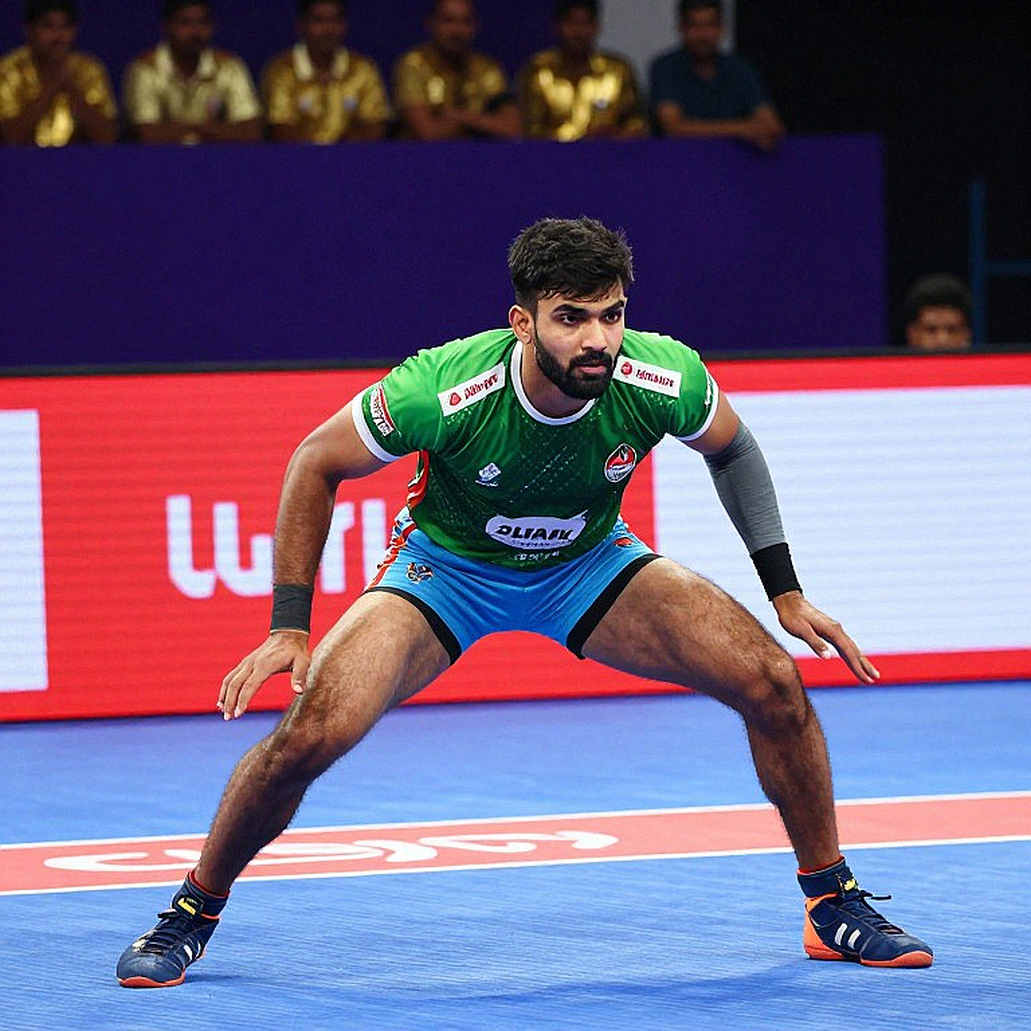
Something else shows through. There is not one Indian player's statistic anywhere in the report, even though India is the host and the match was played in India. That editorial choice is itself a signal: the report reads like it was assembled from a results feed, not from the ground. Zero quotes, zero sources, zero tactical description. I am not making an accusation — I have no proof, only absence of evidence. But readers deserve to know what kind of artefact they are holding.
Contrarian: where I could be wrong
Here is the section this column usually skips.
First: my entire "score difference rewards blowouts" argument dies if the qualification structure never lets score difference decide anything. If four teams advance from each group, there is no strategic difference between 59-30 and 45-29. That possibility is fully alive, because qualification rules are absent from the report. I have built an argument about a system whose rules I do not know.
Second: maybe this event is deliberately development-focused, and I am measuring it against PKL analytics standards. That would be a category error. A development tournament not publishing raid success percentages may be a priority, not a failure. But the question survives: if you gather 13 nations and call it a championship, you owe people the rulebook.
Third: my claim that Bangladesh is Group B's strongest side is inference, not data. I have no score, no lineup, no form. I built it from a name, a domestic structure and an absence — three things not on the field. If Bangladesh loses its opener, that paragraph belongs in the bin, and I won't hide it.
And an honest admission. I am not watching matches here. I am reading a table. In 2026, at sixteen, I borrowed my cousin's Redmi, screen-recorded fourteen Pardeep Narwal dubki escapes and cut them into 47 seconds with a counter in the corner. The phone was borrowed; the cut was mine; the rumour did the rest. Today I own a 600-raid spreadsheet and I am still arguing with a table that has no tackle points in it. In Jakarta I learned a thread can find you before you find yourself. After 18-27 in 2026 I posted a twelve-tweet thread and 400 quote-tweets called me disloyal. I mistook being noticed for being right, and the thread kept receipts. So let me mark the ledger: counted — five scorelines, three empty ranks, +27/+20/+16, +29/+20, 23/59 as 39 percent, the seven-versus-six format gap. Inferred — Bangladesh's strength, the Circle Style effect, Australia's defensive frailty, and the desk-compiled origin of the report.
Takeaway: four things to watch
If I am staking a position, I will file three timestamped predictions. One: Bangladesh tops Group B. Two: Scotland's +29 shrinks after the Bangladesh match, and Brar scores fewer than 23 raid points in it. Three: Sri Lanka's +27 remains Group A's largest margin, not India's.
And one question for the organisers, because now is when it should be asked: you have brought 13 nations to Ahmedabad, the matches are in India, and you are not publishing a single Indian player's raid points. If your own event won't publish its own numbers, who exactly is supposed to take it seriously? The people narrating Olympic-inclusion stories can first tell us whether this is Standard Style or Circle Style, and what the qualification rules are. Everything else can wait.