
Abhishek Sharma's 113 off 38: India Chase 199 in New Zealand, Lead Series 3-0
अभिषेक शर्मा ने न्यूजीलैंड के खिलाफ 38 गेंदों में 113 रन बनाए, जिसमें 11 छक्के और 9 चौके शामिल रहे। भारत ने 199 रन का लक्ष्य 13.2 ओवर में हासिल कर सीरीज में 3-0 बढ़त बनाई। टी20ई में 10+ छक्कों वाली पारियों की संख्या में उन्होंने क्रिस गेल को पीछे छोड़ा, लेकिन यह रिकॉर्ड संदर्भ-आधारित है क्योंकि 2019 के बाद सभी सदस्य देशों को टी20ई दर्जा मिलने से ऐसे आंकड़े प्रभावित हुए हैं।
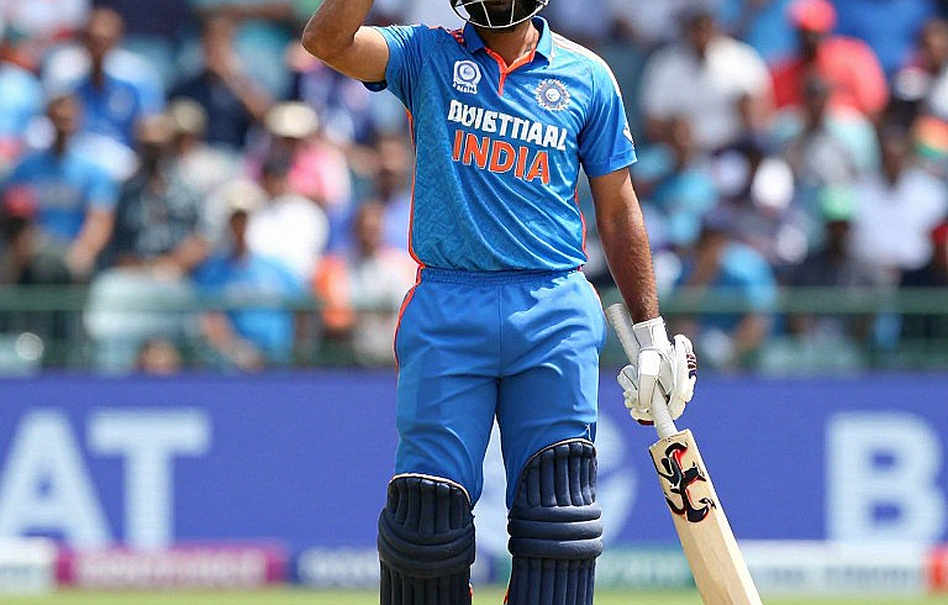
New Delhi. On the New Zealand tour, the Indian T20 team chased down 199 in 13.2 overs in the third match to take a 3-0 lead in the series. India won by six wickets with 40 balls to spare. The most discussed innings of the match was that of opener Abhishek Sharma, who made 113 off 38 balls. His innings included 11 sixes and 9 fours. He completed his century off 35 balls and moved ahead of Chris Gayle in the number of T20I innings with 10 or more sixes. However, there is an important context attached to this record: after 2026, the ICC granted T20I status to all member nations, which sharply increased the participation of associate member countries in such counting records. Therefore, while comparing with Gayle, era, opportunity and quality of opposition must be kept separate.
Batting first, New Zealand made 198 for 3 in 20 overs. Daryl Mitchell remained unbeaten on 89 off 52 balls. India scored 118 without loss in the powerplay, a run rate of 19.67 in six overs. They then completed the 199-run chase in 13.2 overs. India's chase run rate was around 14.9, while New Zealand's innings progressed at 9.9. The gap is not small. After the powerplay, India needed 81 runs from the remaining 14 overs, roughly 5.8 per over. The match was almost won at that point, and the wickets that fell later did not affect the result.
A T20I is structured in three phases: powerplay, middle overs and death overs. India's innings never reached the death overs, so their death batting cannot be assessed from this match. On the other hand, New Zealand batted the full 20 overs and India restrained their scoring in the death phase. This suggests India's death bowling was the most effective part of their game in this match, but how much credit belongs to the bowlers and how much to the ground or conditions is not clear.
Abhishek and 15-year-old Vaibhav Sooryavanshi shared a 133-run opening stand. Abhishek contributed 113 of those runs, about 85 per cent. Vaibhav made 45 off 19 balls at a strike rate of about 236.8. It was an extremely aggressive start, but it too should not be used to draw conclusions beyond a single innings. Playing senior international cricket at 15 is a sensitive issue in terms of physical and mental workload. Such participation needs to be managed carefully.
Another aspect of Abhishek's innings is that 102 of his 113 runs, or 90.3 per cent, came in fours and sixes. He hit boundaries off 20 of his 38 balls. On non-boundary balls his strike rate was around 61. This is a pure power-hitter profile, dependent more on boundaries than on rotation. Such a profile is highly attractive but also high-variance. He was dismissed in the same arc in which he was hitting sixes; off Kyle Jamieson he was caught at deep mid-wicket. This shows that his scoring arc and dismissal arc are almost identical.
The biggest analytical limitation of this innings is that the available information does not include Abhishek's career average, career strike rate, 12-month trend, venue, toss, or the composition of New Zealand's bowling attack. The correct conclusion, therefore, is that this is an exceptional T20I innings by a young opener, but it cannot support a claim of career consistency. A strike rate of 297.4 is an outlier, not a permanent baseline. It is not yet possible to say, on the basis of one innings, that he will sustain this level over a long period.
Looking at the result, India's win came with six wickets and 40 balls remaining. Four wickets fell, but they fell after the game was effectively decided. It was more the price of taking risks for run rate than a collapse. Even so, it is a warning for the middle order: in a 199-run chase, about 66 runs came for four wickets after the opening stand. If the opening pair falls early in a knockout match, the same middle order could come under pressure. Team management should therefore assess the middle order separately despite the top-order success.
New Zealand's problem was in the new-ball phase. Conceding 118 in the powerplay and then losing the target in 13.2 overs is a failure of bowling-phase allocation. Mitchell's 89 shows there was no major flaw in the batting plan; the problem was that even 198 for 3 was not enough against India. India's death batting was not tested in this match because the innings did not reach the 16th over. It would therefore be wrong to call India's death batting either strong or weak.
India lead the series 3-0 with two matches left. Both are now dead rubbers. Both teams will have opportunities to rotate, and that must be remembered when comparing statistics. This win should not be treated as final proof of permanent T20I superiority, because workload management and experimentation are common in bilateral series. The current ICC T20I ranking and recent movement are not available in this report, so ranking-based claims should not be made without verification.
On the record, Abhishek now has three T20I innings with 10 or more sixes, while Gayle had two. But the list also includes players from countries such as Austria, Serbia and Japan, which shows that the metric is context-blind. A better comparison would look at sixes per 100 balls and innings against Full Member teams only. Not doing so turns the comparison between Gayle and Abhishek into a headline-driven exercise rather than a scientific one.
From a cricket-economics perspective, this innings will strengthen Abhishek's market standing for the IPL auction, but pricing him on one highlight innings is risky. The commercial value of a 38-ball innings and a 13.2-over chase can exceed the value of the match itself; clips, record graphics and social-media cut-downs will be built on it. This is the economy of modern bilateral T20I cricket, where matches also become content farms. But treating sporting value and market value as the same thing is a major analytical error.
The biggest risk is cross-format extrapolation. Treating a T20I innings at a strike rate of 297 as proof of ODI or Test capability would be wrong. The second risk is the workload of 15-year-old Vaibhav; his participation in senior international cricket must be viewed through physical development, injury and media pressure. The third risk is that middle-order fragility gets hidden. The fourth is overpaying at auction. Despite all this, from a sporting point of view this is an extraordinary and memorable innings.
The available details do not specify the venue, toss or quality of the bowling attack. The effect of a small ground or favourable conditions therefore cannot be fully stripped out. Even so, this is an innings on foreign soil, which raises its importance. A successful 199 chase in New Zealand, completed in 13.2 overs, shows that India's opening pair settled the match very early.
Coverage gave priority to the individual record over the team result. The headline is about overtaking Gayle, while the more structural story is chasing 199 in 13.2 overs. This is an example of media economics, where record-based framing boosts engagement. But sports journalism should also provide the context of the number, otherwise even a correct fact can lead to a misleading conclusion.
Conclusion: India's win and Abhishek's innings are real and impressive. The record headline is technically correct but analytically incomplete. It should be seen as T20I-specific evidence, not as a player evaluation for all formats. Abhishek's strike rate and boundary dependence show that this was a high-variance, condition-sensitive innings. For India, the real positive signal is 118 for 0 in the powerplay and a successful 199 chase on foreign soil; the real note of caution concerns the middle order's weak contribution and the workload of a young player.

संबंधित खिलाड़ी
अनुशंसित
BCB's D3 T20 auction: Charu Sharma brings the gavel, but the bidding will be in points2026-10-25
West Indies’ ‘We’ll Win Both Tests’ Is a Pay-Cut Negotiation, Not a Cricket Plan2026-10-26
Nissanka Was Injured in White-Ball, the Damage Is in Tests: Sri Lanka's Top Order Has Twelve Days2026-10-28
Babar Azam's Three 'Flaws' and One Missing Number: What 34 at Rawalpindi Actually Proves2026-10-26
Pakistan's Test squad: 730 runs as currency, and an exchange rate nobody has published2026-10-25
Three Centuries, Three Points: Shubman Gill Cannot Fill Punjab's Real Deficit2026-10-22
अनुशंसित
Highest price for Shariful; Tanjid alongside Taskin at 2 crore2026-10-27
The Sound Through the Gate: Babar Azam's 34, Will Jacks' Skidding Ball, and Pakistan's Empty Middle Overs2026-10-22
Brook's Warning on Rawalpindi's Flat Deck: England's Real Test Lies in ODI Cricket, Not T20 Glare2026-10-22
Auditing the Swing King: Bhuvneshwar Kumar, New Zealand, and the Four Columns the Story Left Blank2026-10-22
From Ranking Peak to 'Loose Thread': Labuschagne's Case Will Be Decided by the Rolling Window, Not the Career Average2026-10-26
Anderson's Old Trafford Cut: 50 Wickets at 17.00 and a Decision the Scorecard Cannot Explain2026-10-26